Safer to sign
Scribes make documents faster to write. We make them safer to sign.
Faster is the side effect. Defensible is the point.
Book a demo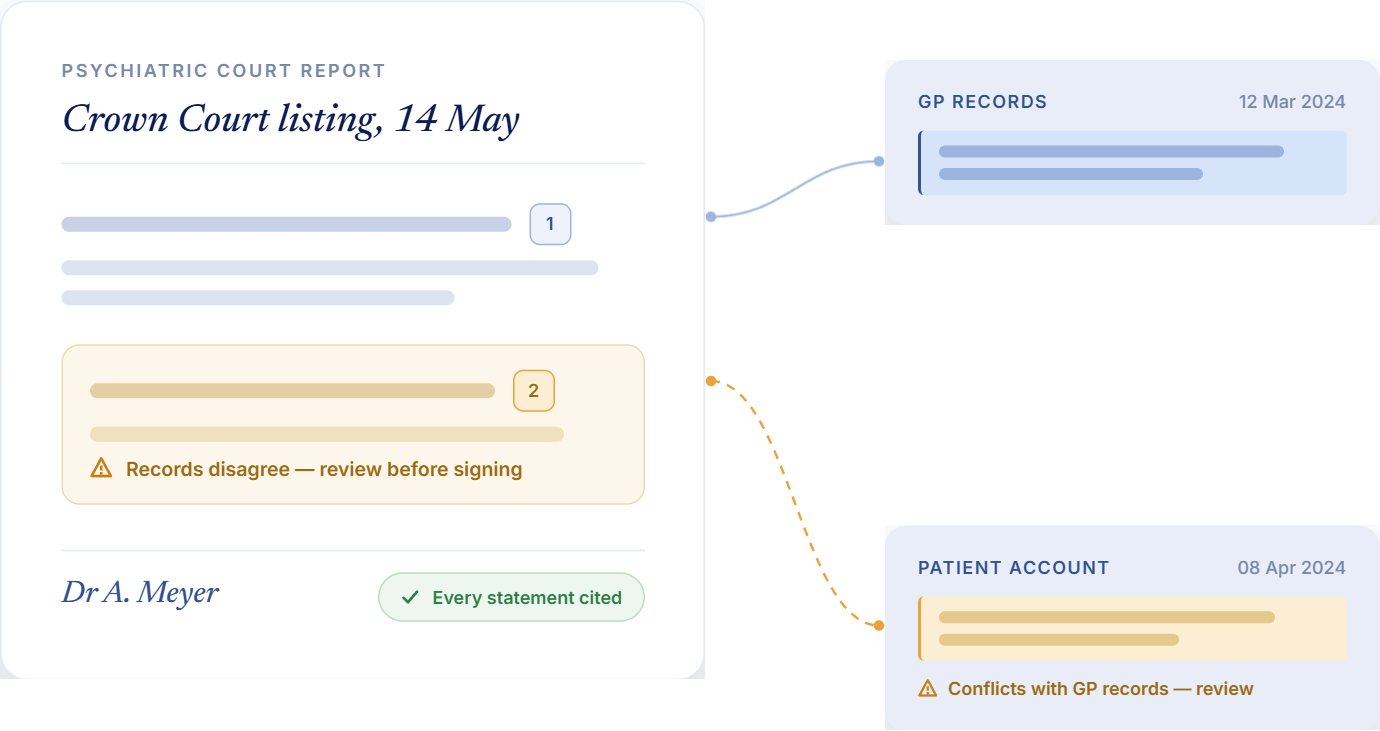
The problem, in numbers
The draft is the easy part.
~1 hour
what clinicians report a single court or medico-legal report takes to produce by hand
Clinician-reported, Aisel timing dataset, Denmark & UK, 2025-26
53-64 min
the reported range across MHA reports, medico-legal reports and court reports; benefits reports ~32 min
Same dataset, n=11-17 per document type
2 hours
of desk and EHR work for every 1 hour of direct patient time in ambulatory care
Sinsky et al., Annals of Internal Medicine, 2016
62%
reduction in clinical-note documentation time with Aisel, stopwatch-timed
Single pilot clinic, n=32 - clinical notes, not heavy reports
Timing figures are clinician-reported estimates (275 entries, 16 task types, 8 clinic settings, Denmark & UK, 2025-26) except the 62% figure, which is stopwatch-timed from one pilot clinic. No AI-assisted timing data exists yet for the heavy report types.
An hour of writing is not the problem. What the hour can't buy is certainty that every statement in it survives scrutiny - that's the part Aisel does.
Where it breaks
The risk isn't slow writing.
The heavy documents - expert court reports, tribunal and Mental Health Act reports, medico-legal certificates, capability and benefits reports - are assembled from months or years of records. The clinician is not really writing; they are reconstructing.
The risk isn't slow writing. It's an unsupported statement, a missed contradiction, or an unanswered statutory question surviving into a signed document. Those errors carry legal weight, not editorial weight.
A faster draft makes that risk worse, not better, if nothing checks the draft. Speed without verification is just faster liability.
For clinics, this is also an economics problem. Medico-legal work is among the best-paid work a clinic does, and preparation time is the bottleneck - verified reports in a fraction of the time means more instructions accepted, without more risk carried.
How Aisel handles it
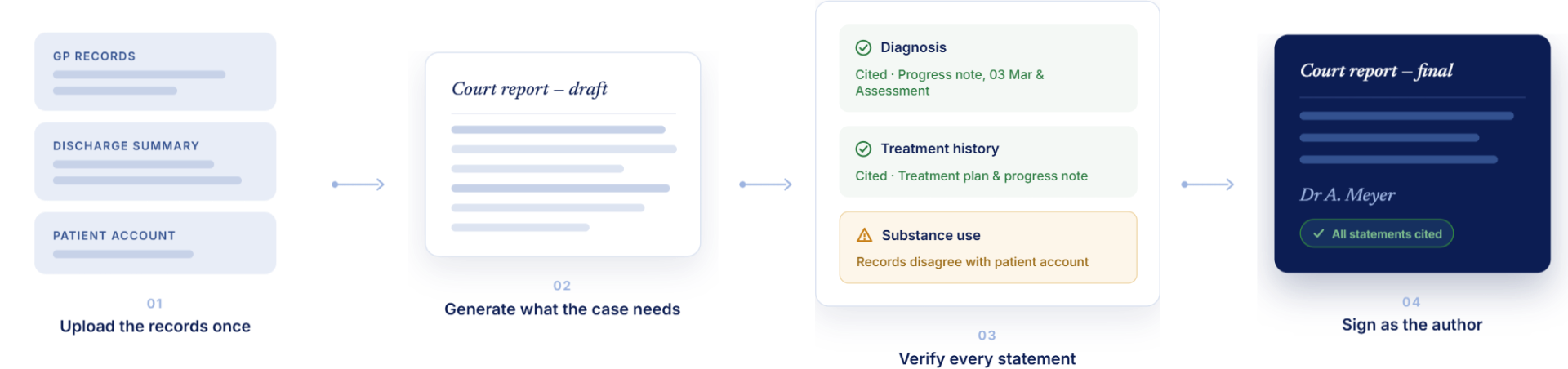
Assemble. Verify. Sign.
- 01
Upload the patient's records once.
Every document that matters to the case, in one place.
- 02
Generate the document the case needs.
Expert court report, tribunal or MHA report, medico-legal certificate, capability or benefits report.
- 03
Verify: every statement cited to its source, side by side.
Click any sentence to see the passage it came from.
- 04
Review flags: contradictions between records or with the patient's account, with an accuracy indication.
Nothing hidden. Every disagreement surfaced for the clinician's judgement.
- 05
Close the gaps: the completeness check measures the report against what it's required to answer.
Statutory questions, court instructions, insurance criteria - nothing left unanswered.
- 06
Sign - as the author, with the evidence attached.
The clinician is the author of record. The citations travel with the document.
- 07
At discharge, the data is deleted; re-upload anytime.
Records are not retained. If the case reopens, upload again.
Evidence, never opinions
The division of labour is the design.
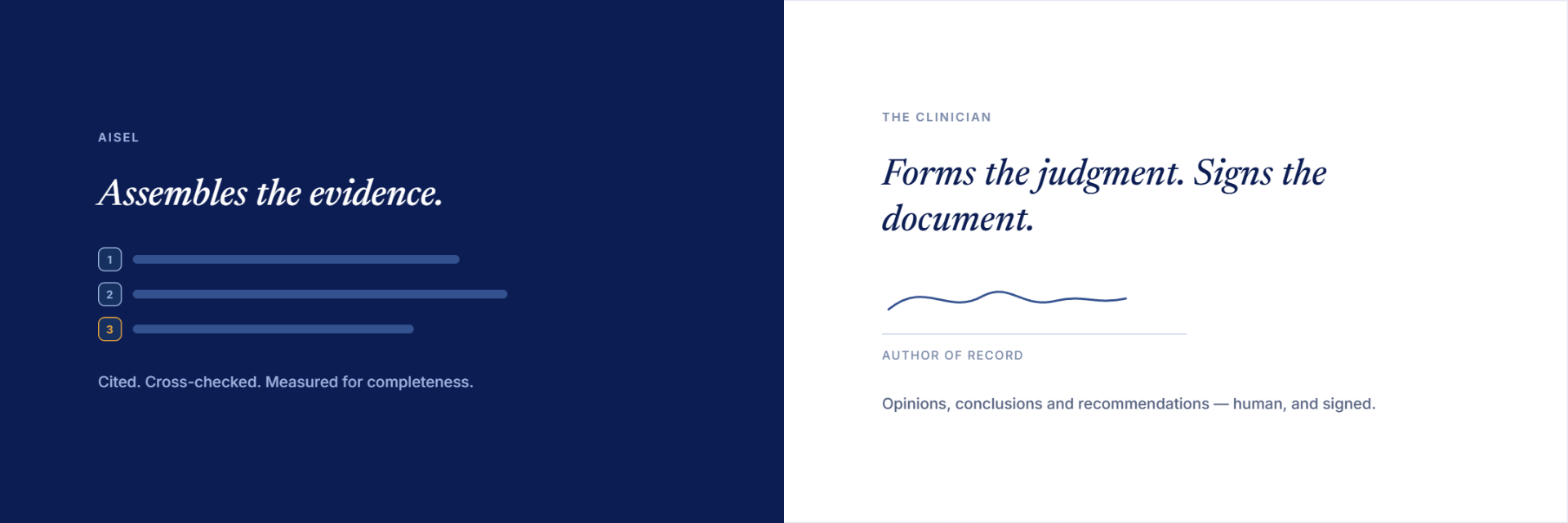
Aisel never generates clinical opinions. It assembles, cites and checks the evidence; the clinician forms the judgment, authors the conclusions, and signs. That division of labour is not a limitation - it's the design.
Frequently asked
Questions clinicians ask.
What document types does Aisel support?
+
Expert court reports, tribunal and Mental Health Act documentation, medico-legal certificates, capability and benefits reports, plus clinical notes, referral letters, summaries and treatment plans.
Does Aisel write the clinical opinion?
+
No. Aisel assembles and cites evidence; opinions, conclusions and recommendations are authored by the clinician.
How does citation verification work?
+
Every statement links to the passage in the source records it came from, shown side by side for review before signing.
What happens to patient data afterwards?
+
Deleted at discharge. Records can be re-uploaded if the case reopens.
Is Aisel compliant for medico-legal work?
+
Aisel is GDPR-compliant, ISO 27001 certified and end-to-end encrypted with UK/EU data residency. The signing clinician remains the author of record.
Scale without compromise
See how Aisel removes friction where it costs most. A 20-minute walkthrough tailored to your clinic.